


TX Cream Dark Spot Corrector
TX Cream Dark Spot Corrector
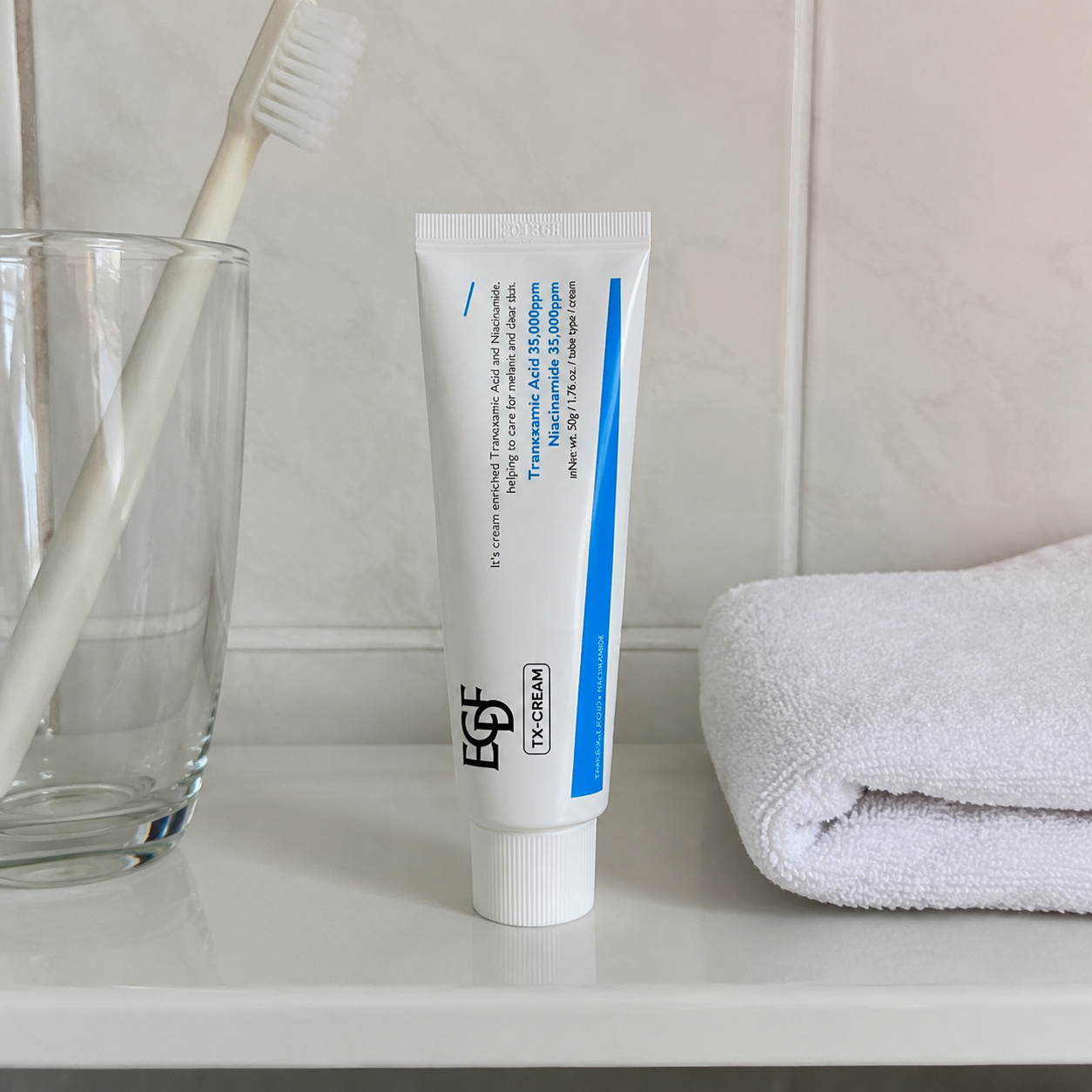
Tranexamic acid 3.5% + niacinamide 3.5% — both printed on the tube
Order today — get it between - and -.
Shipping & returns
Shipping & returns
Free tracked shipping, dispatched within 24–48 hours, typically 5–7 business days in the US. Full refund within 30 days of delivery.
What's in the box
What's in the box
One 50 g / 1.76 oz tube. Tranexamic acid 35,000 ppm (3.5%) and niacinamide 35,000 ppm (3.5%), in a cream base. Use morning and night, always with daily sunscreen.
30-day money-back guarantee
30-day money-back guarantee
Thirty days tells you whether your skin tolerates it, not whether it works — that takes twelve weeks. Full refund within 30 days of delivery, opened tube included.

TX Cream Dark Spot Corrector


 Skincare
Tranexamic acid 3.5% + niacinamide 3.5% · 50 g cream · both numbers on the front
Skincare
Tranexamic acid 3.5% + niacinamide 3.5% · 50 g cream · both numbers on the front
Hydroquinone comes with a countdown. Then what?
Four months, your dermatologist said, and then off it. Nobody told you what comes next, and this is the part where a lot of people watch the whole thing undo itself.
“This is the part that always sets me back after I have to come off HQ.”
This is a cosmetic cream, not a prescription and not a course. There’s no four-month limit on it and nothing to taper off. That’s the slot it’s built for: the one you stay on.
 Both numbers, on the front
Go and check what’s on your current tube
Tranexamic acid
Topical studies in this space typically run between 2% and 5%. This sits in the middle of that range.
Niacinamide
Inside the 2–5% band people are repeatedly advised to stay in — not the 10% that keeps coming up in comment sections next to the word “breakout”.

Most brands don’t print the percentage anywhere
This is a category that buys on numbers, and it is remarkable how many tubes carry a long ingredient list and no concentration at all. Both of ours are on the front panel in blue.
You can hold this page next to whatever is currently in your bathroom and compare like for like. That’s the point.
Get the tube — $39.99The objection nobody in this category answers“Topical tranexamic acid doesn’t work”
You will have seen this said, and by people who know what they’re talking about. It deserves a straight answer rather than being ignored.
The argument is about getting the molecule in. Tranexamic acid is water-soluble, and your skin’s outer barrier is lipid — oily. A thin, watery serum has a hard job carrying a water-soluble active across an oily barrier. That is the real substance of the criticism, and it’s a criticism of the vehicle more than of the ingredient.
This is a cream, not a serum. An emulsion with an oil phase is a different delivery problem from a water-based drop. That is the reason for the format, and we’d rather tell you the argument exists than pretend it doesn’t.
What we won’t do is tell you it’s settled. The evidence on topical tranexamic acid is genuinely mixed. If you want certainty, this whole category is the wrong place to look for it.

Left: a watery drop sitting on the surface. Right: a cream worked into a film. Same forearm, same light.
How to actually use itOne step, and the one that matters more

A pea-sized amount
Morning and night on clean skin, to the areas you care about or all over. It’s a cream, so it can be your moisturiser step.

Pat, don’t drag
Let it settle for a minute before anything goes on top. No rubbing at pigmented areas — friction is not on your side here.

Then sunscreen. Every day.
This is not optional and it is not us covering ourselves. Without daily SPF, nothing in this category holds — ask any dermatologist who works with pigmentation.
The honest timelineThree months. Not four weeks.
Weeks 1–2
Nothing visible. You’re establishing the habit and finding out whether it suits your skin. Patch test first and watch for irritation.
Weeks 3–6
Still nothing you could photograph. Skin turnover takes about a month, and pigment sits deeper than the surface you can see changing.
Weeks 8–12
If it’s going to do something for you, this is where you’d start to notice it — in overall evenness rather than one spot vanishing. Same mirror, same light, or you’ll fool yourself either way.
After that
There’s no stop date. This is the maintenance slot — the thing you keep using, alongside sunscreen.
Anyone promising you four weeks is selling you something. And if you don’t see a change by three months, this one isn’t working for you — that’s a real outcome and it happens.
Built for deeper skin tones firstThe people most affected, and most often harmed

Pigmentation is most visible, most persistent and most likely to have been made worse by aggressive treatment in brown and black skin. That is where the serious conversation about this ingredient happens, and it’s who this page was written for.
Two things follow from it, and they’re both cautions rather than sales points. Aggressive is not faster. Harsh acids, scrubbing and over-treating cause post-inflammatory hyperpigmentation — the exact thing you’re trying to fix. And if you are hyperpigmentation-prone, lasers are not a shortcut; more than one person in our research came out of that darker than they went in.
Gentle, boring and daily beats intensive every time here.


 Where it goes in your routine
It replaces four serums, not your sunscreen
Morning: cleanse → TX Cream → sunscreen. That’s it. If you use a vitamin C, put it before this one.
Night: cleanse → TX Cream. If you use a retinoid, alternate nights to begin with rather than stacking them, and stop if you get irritated — irritation is what causes more pigmentation.
Don’t layer it with a strong exfoliating acid in the same routine while you’re finding out how your skin takes it.
It’s a cream texture, so for a lot of people it can simply be the moisturiser step rather than an extra one.
 In their own words
The arguments this product walks into
“Your recommendation of niacinamide 10% is causing heavy breakout to people”
“Is 5% TA too high to be using on our skin? Is 2% safer?”
“They will come back worse once you stop. Hydroquinone is a no go zone for me.”
“The derm told me to not be on hydroquinone for longer than 4 months”
Comments collected from public dermatology and skincare videos during research for this product. Not customer reviews of this cream.
Let's be straight with youWhat this is, and what it isn’t
It is a cosmetic, not a medicine. It is not hydroquinone, it is not a prescription, and it is not a treatment for melasma or any other diagnosed condition. If a doctor is managing your pigmentation, talk to them before you add anything.
There are no before-and-after photos on this page. Deliberately. This audience examines them properly and most of the ones in this category are shot in different light at a different angle. When we have honest ones — same mirror, same light, unretouched — we’ll put them up.
It will do nothing without daily sunscreen. Sun exposure is what drives most of this. Using a corrector without SPF is bailing out a boat without plugging the hole.
The evidence for topical tranexamic acid is mixed. We’ve set out the argument above rather than hiding it. Three months at 3.5% in a cream is a reasonable thing to try; it is not a guarantee, and we’re not going to pretend otherwise.
Against the alternativesHonest comparison
| TX Cream 3.5% | Prescription hydroquinone | Oral tranexamic acid | A 10% niacinamide serum | |
|---|---|---|---|---|
| No prescription needed | ✓ | ✗ | ✗ | ✓ |
| No stop date or course length | ✓ | ✗ | ✗ | ✓ |
| Concentrations printed on the pack | ✓ | ✓ | ✓ | ✓ |
| Niacinamide inside the 2–5% band | ✓ | ✗ | ✗ | ✗ |
| Cream vehicle, not a watery serum | ✓ | ~ | ✗ | ✗ |
| No systemic side effects to weigh up | ✓ | ~ | ✗ | ✓ |
| Strongest clinical evidence base | ✗ | ✓ | ✓ | ✗ |
| Medically supervised | ✗ | ✓ | ✓ | ✗ |
Two crosses in our own column, and they’re the important ones. Prescription hydroquinone and oral tranexamic acid have far stronger evidence behind them and a doctor watching over you. What they don’t have is somewhere to go when the course ends.
4.5 / 5 — 2,180 verified reviewsWhat buyers say
Came off HQ in March and needed something to stay on. This is it.
3.5% niacinamide instead of 10%. My skin stopped protesting.
Three months in. Evener overall, not one spot gone. Honest answer.
 Customer reviews
4.5 out of 5
My derm gave me four months of HQ and no plan for month five. This is what I use now, with SPF every day.
10% was breaking me out and I didn't connect the two for a year. 3.5% has been fine.
Not dramatic. More even overall. I took photos in the same spot each month, which is the only way to tell.
I wanted faster. The page told me twelve weeks and it was right, which I'd rather have than a promise.
It's my moisturiser step now instead of an extra one. Sits fine under sunscreen.
30Day guaranteeThirty days to find out if it suits your skin
Thirty days won’t tell you whether it works on your pigmentation — that takes twelve weeks and we’re not going to pretend otherwise. What it will tell you is whether your skin tolerates it, whether the texture sits under your sunscreen, and whether it fits your routine. If any of that is a no, send it back within 30 days of delivery for a full refund, opened tube included.
Get the tube — $39.99Questions? We've got answersFrequently asked questions
Is 35,000 ppm a lot?
It’s 3.5%, written the Korean way. It looks enormous and it isn’t — it’s a normal clinical dose. Topical tranexamic acid studies typically run 2–5%, so this sits in the middle.
Why only 3.5% niacinamide when other brands do 10%?
Because 2–5% is the range people are repeatedly advised to stay in, and 10% products keep appearing in comment sections attached to breakouts and irritation. More is not automatically better here.
Does topical tranexamic acid actually work?
It’s genuinely debated, and we’ve set the argument out on this page rather than hiding it. The criticism is mainly about delivery — tranexamic acid is water-soluble and your skin barrier is lipid, which is a hard job for a watery serum. That’s why this is a cream. It isn’t a guarantee.
Can I use it instead of hydroquinone?
It is not hydroquinone and it is not equivalent to it. It’s a cosmetic cream with no course length, which is why people use it in the maintenance slot after a prescription course ends. If a doctor is treating you, ask them first.
Do I really need sunscreen with it?
Yes, and it’s not a disclaimer. Sun exposure drives most pigmentation. Every dermatologist working in this area says the same thing: without daily SPF, nothing else you do holds.
How long before I see anything?
Around twelve weeks, if at all. Weeks one to six will look like nothing is happening because skin turnover takes about a month and pigment sits deeper than that. Photograph yourself in the same spot and the same light each month, or you’ll fool yourself in both directions.
Can I use it with retinol or vitamin C?
Vitamin C in the morning before this one is fine. With a retinoid, alternate nights while you find out how your skin takes both, and don’t stack strong exfoliating acids on top — irritation causes more pigmentation, which is the opposite of the point.
Is it safe if I'm pregnant or breastfeeding?
Talk to your doctor or midwife before using any new active skincare during pregnancy or breastfeeding. We’re not in a position to advise on that.
Will it work on acne marks?
Post-inflammatory marks and sun-driven pigment behave differently and both take months. The one thing that matters more than the product is not picking and not irritating the area while it settles.
What’s the size?
50 g / 1.76 oz. Used morning and night on the face, that’s a couple of months for most people.
Can I get the full ingredient list?
Email us before you order and we’ll send the complete INCI list for the formula.
What’s shipping like?
Orders ship within 24–48 hours with tracking, typically 5–7 business days in the US.
SkincareCosmetic skincare product for external use on the face. This is not a drug and not a medicine. It is not intended to diagnose, treat, cure or prevent any disease or condition, including melasma or post-inflammatory hyperpigmentation, and nothing on this page is medical advice. It is not hydroquinone, not a prescription product and not equivalent to one — if you are under the care of a doctor or dermatologist for pigmentation, speak to them before adding any product. Concentrations shown (tranexamic acid 35,000 ppm and niacinamide 35,000 ppm, i.e. 3.5% each) are as printed on the manufacturer’s packaging. Evidence for topical tranexamic acid is mixed and results vary considerably from person to person; many people see no change. Daily broad-spectrum sunscreen is required for any pigmentation routine to hold. Patch test on a small area before first use, avoid the eye area, and discontinue if irritation, stinging or increased redness occurs. Do not use on broken or sunburned skin. Consult a doctor before use if you are pregnant, breastfeeding or taking medication. Keep out of reach of children. Full ingredient list available on request. Reviews reflect individual experiences.